Patna: Veteran Bihar politician Nitish Kumar, the longtime leader of the Janata Dal (United) or JD(U), has formally announced his move to the Rajya Sabha, signaling the end of his near two-decade dominance in Bihar politics. Known for his political agility—and sometimes criticized as opportunistic—Kumar has been nicknamed “Paltu Ram” by opponents, referencing his repeated alliance shifts over the years.
From leaving the NDA in 2013 to joining the RJD-led Mahagathbandhan in 2015, returning to the NDA in 2017, rejoining the opposition in 2022, and flipping back to the NDA ahead of the 2024 Lok Sabha polls, Kumar’s maneuvers have often been described as pragmatic survival tactics, though detractors have labeled them as unreliable and unpredictable.
This pattern of alliance changes has had profound effects on Bihar’s governance. The Coalition instability, frequent resignations, and multiple oath-taking ceremonies—Nitish Kumar has been sworn in as Chief Minister a record 10 times—have at times overshadowed long-term policy planning. Despite these challenges, Kumar earned the moniker “Sushasan Babu” for improving infrastructure, education, women’s empowerment, and law and order in the state. Yet, the constant political recalibrations contributed to perceptions of uncertainty, delayed reforms, and mounting state debt, as short-term coalition management often took precedence over strategic initiatives.
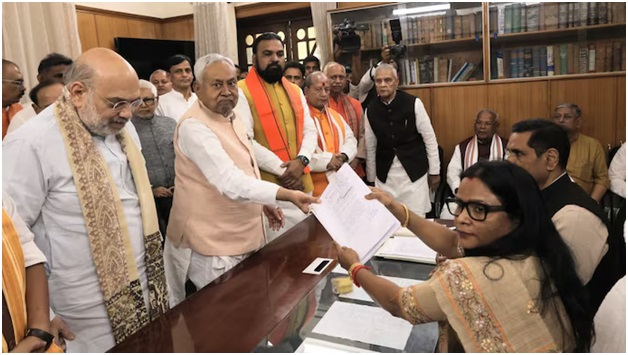
The recent announcement comes after a decisive NDA victory in the 2025 Bihar Assembly elections, where the alliance secured around 202 seats out of 243. Having taken oath for his tenth term in late 2025, Kumar filed his Rajya Sabha nomination amid speculation of health considerations, a desire to influence national politics, and facilitating a transition in state leadership.
He assured continued “full cooperation and guidance” to the incoming government, indicating he will step down as CM before April 2026, ahead of his upper house term beginning post-elections on March 16.
Kumar’s exit marks the close of a significant chapter in Bihar politics. The NDA remains intact, with the mandate allowing a shift from JD(U)-led leadership to a BJP-dominant government. With the BJP as the larger partner, Bihar is likely to witness its first BJP chief minister, changing internal dynamics and reducing the risks associated with Kumar’s frequent alliance shifts.

The government can now focus more steadily on delivering development-oriented programs such as the “Saat Nischay-3” initiative, expanding higher education access, women’s employment schemes, farmer support measures, and the vision of a “Viksit Bihar” with an ambitious ₹3.47 lakh crore budget for 2026-27.
Speculation over Kumar’s successor centers on BJP leaders to maintain caste and regional balance, particularly from Backward and Extremely Backward Classes. Names under discussion include Deputy Chief Ministers Samrat Choudhary and Vijay Kumar Sinha, with others like Dilip Jaiswal or Sanjeev Chourasia also in the fray. JD(U) options, including Kumar’s son Nishant Kumar, appear less likely as the transition favors BJP ascendancy. Central leadership, including the presence of Union Minister Amit Shah, is expected to play a key role in consultations and nominations.
Overall, Nitish Kumar’s move to the Rajya Sabha—despite his shifting allegiance legacy—occurs at a time of NDA stability and electoral strength. This transition offers Bihar an opportunity for more predictable governance, focusing on development and long-term policy execution, potentially consolidating the foundations laid during Kumar’s tenure while reducing political disruptions of the past. It marks both the end of an era and the beginning of a BJP-centric phase in Bihar politics, with continuity in governance and a renewed emphasis on delivering tangible progress.